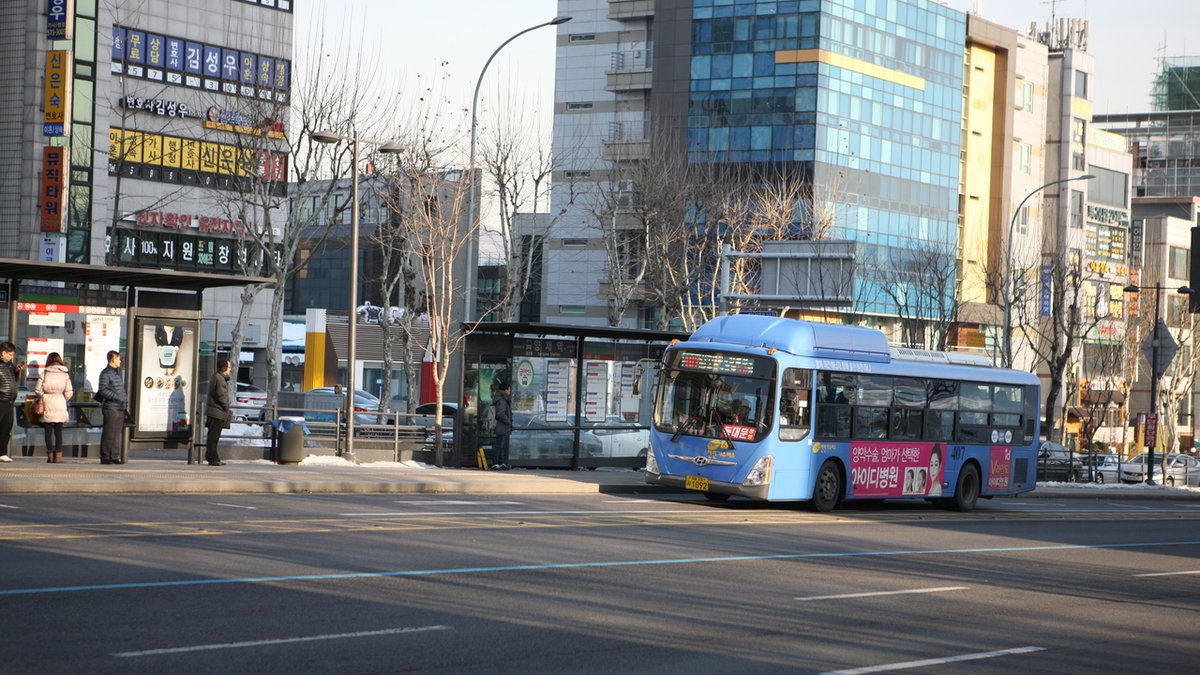
Seoul's city buses are cheap, frequent and easy once you know three things: the color tells you the kind of route, an adult ride costs 1,500 won on a blue or green bus with a transport card (Seoul city, as of November 2026), and you must tap your card again when you get off to get free transfers. Many routes no longer take cash, so ride with a T-money card, WOWPASS or Climate Card. Below: what each color means, a full fare table, how to ride step by step, night buses, and worked examples of what a day of rides really costs.
Seoul bus colors at a glance
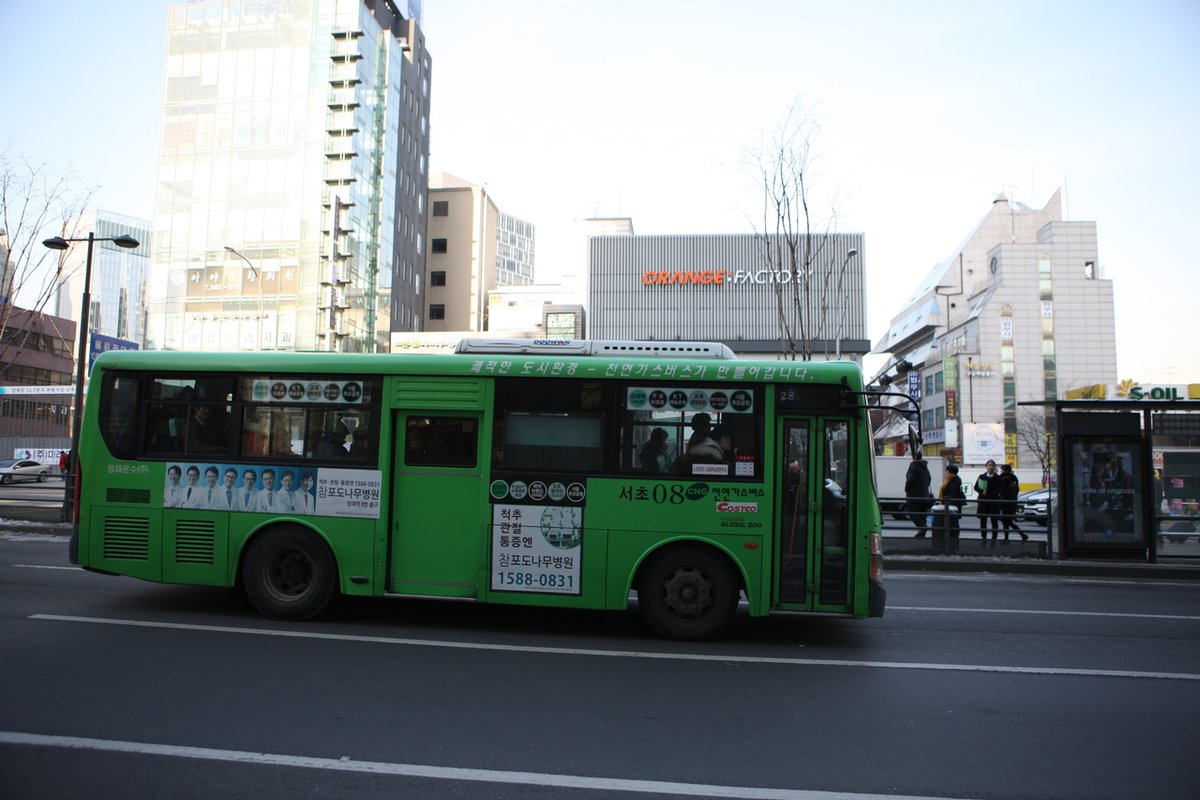
Seoul's transport information center, TOPIS, divides Seoul buses into blue, green, yellow, red, customized and night (N) buses, plus airport buses. For a visitor, this is what the colors mean:
| Color | Korean name | What it does | Number pattern (TOPIS) |
|---|---|---|---|
| Blue | 간선 (trunk) | Long routes across the city, often in the center-lane bus lanes | 3 digits, e.g. 109, 402 |
| Green | 지선 (branch) | Shorter local routes that link neighborhoods to subway stations | 4 digits, e.g. 7011 |
| Yellow | 순환 (circular) | Loops around a central area | 2 digits |
| Red | 광역 (wide-area) | Express routes between Seoul and nearby cities | Starts with 9, e.g. 9xxx |
| Small green | 마을 (village) | Very short neighborhood routes, named after the district (e.g. "Jongno 11") | District name + number |
| N | 심야 (night) | "Owl" buses after midnight | Starts with N, e.g. N13 |
Reading the number: on blue and green buses, the first digits are the start and end areas. TOPIS says area 0 is the city center (Jung-gu, Jongno-gu and Yongsan-gu). You don't need to memorize this: Naver Map and KakaoMap show the exact bus number, stop and arrival time (see our Naver Map vs Google Maps guide).
Seoul bus fares in 2026
These are Seoul city's official fares (table in force since 12 August 2023, page updated 9 March 2026). Prices are in won.
| Bus | Adult, card | Adult, cash | Teen, card | Child, card | Adult, early-bird card |
|---|---|---|---|---|---|
| Blue / green | 1,500 | 1,500 | 900 | 550 | 1,200 |
| Yellow circular / some short green routes | 1,400 | 1,400 | 800 | 500 | 1,120 |
| Village (마을) | 1,200 | 1,200 | 600 | - | 960 |
| Red wide-area | 3,000 | 3,000 | 1,700 | 1,500 | 2,400 |
| Night (N) | 2,500 | 2,500 | 1,600 | 1,400 | - |
Key rules (Seoul city): - Riding a Seoul city or village bus on its own is a flat fare. You pay the same however far you go. - Early-bird discount: pay by card for your first ride before 06:30 and you get 20% off the base fare. - Children under 6 ride free, up to three per paying guardian. - Teen and child fares only apply if the card is registered as a teen or child card (Seoul city points to T-money for how to register). An unregistered card pays the adult fare. On a bus, the driver can also set the fare type for you. - Wide-area red buses include the first 30 km in the base fare when you use them in a transfer, instead of the usual 10 km (Seoul city).
How to ride a Seoul bus, step by step
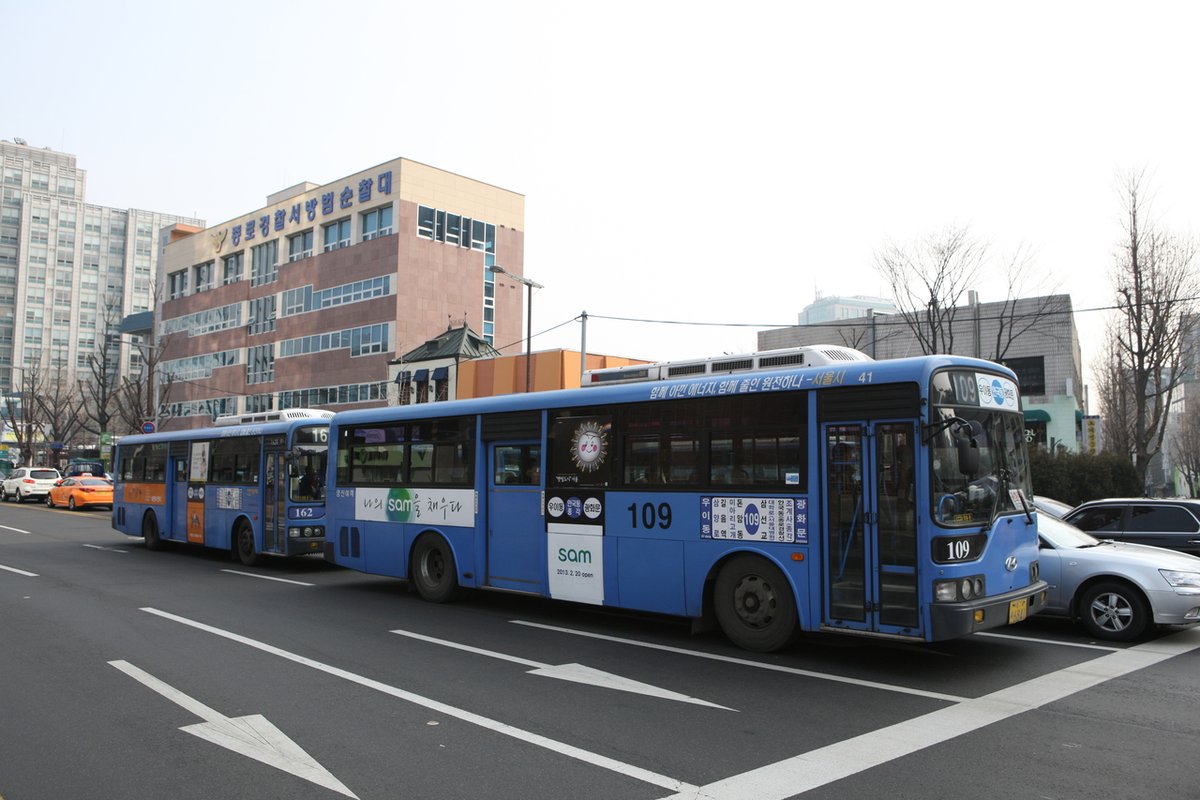
- Find your stop and bus number in Naver Map or KakaoMap. Many blue buses stop at center-lane stops in the middle of the road; check which side of the street your stop is on.
- Check the number on the front of the bus as it pulls in, and be ready at the stop.
- Get on at the front door and tap your card on the reader next to the driver. You'll hear a beep. If two people share one card, tell the driver before you tap.
- Press a "stop" button before your stop. Follow your map app so you know when your stop is next.
- Tap your card again at the rear door as you get off. This step is easy to forget and it matters.
- Hold on. Buses start and stop quickly; stand away from the doors.
Why you must tap off
Seoul city says you should tap your card every time you get on and get off. If you don't tap off, the transfer chain breaks: on your next ride you're charged a new base fare, and the distance fare from the ride you didn't tap off may be charged too. Tapping off costs nothing and keeps your transfer discount.
Free transfers between buses and the subway
With a transport card, Seoul treats a whole trip on buses and subways as one journey (Seoul city's integrated transfer system):
- Time limit: board the next bus or subway within 30 minutes of getting off, or within 60 minutes between 21:00 and 07:00.
- Up to 5 rides in one journey (4 transfers).
- What you pay: the base fare of the most expensive type you used covers the first 10 km; after that, 100 won per 5 km (teens 80, children 50).
- Not a transfer: getting back on the same route or the same bus.
- One card per person. If you share one card, the bus transfer only works when the same group rides together and you tell the driver each time, and it doesn't carry over to the subway.
- Cash never gets a transfer discount. Only cards do.
Worked example: a blue bus (1,500 won) for 4 km, then a subway ride of 5 km within 20 minutes. Total distance 9 km, so you pay the higher base fare once. The subway's adult card fare is 1,550 won (see our Seoul subway guide), so the transfer adds about 50 won and the whole trip costs about 1,550 won, not 3,050.
Night buses (N buses)
Seoul runs 14 "Owl" night bus routes with 140 buses between the city center and the outer districts, from about 23:00 to 06:00, for 2,500 won by card (Seoul city, updated 20 March 2026). Night bus numbers start with N. A few examples from the official timetable:
| Route | From - to | First - last departure | Every |
|---|---|---|---|
| N13 | Sanggye-dong - Jangji-dong | 23:30 - 03:40 | 20-30 min |
| N26 | Banghwa-dong - Sinnae-dong | 00:00 - 03:25 | 20-25 min |
| N30 | Gangil-dong - Seoul Station | 23:10 - 03:50 | 30-35 min |
| N61 | Sinjeong-dong - Sanggye-dong | 23:40 - 04:10 | 10-30 min |
Gaps between buses can be 20-40 minutes, so check the live arrival time in your map app before you leave a bar or club. If no N bus goes your way, a taxi is the backup (see our Korea taxi guide).
Cash, cards and passes on Seoul buses
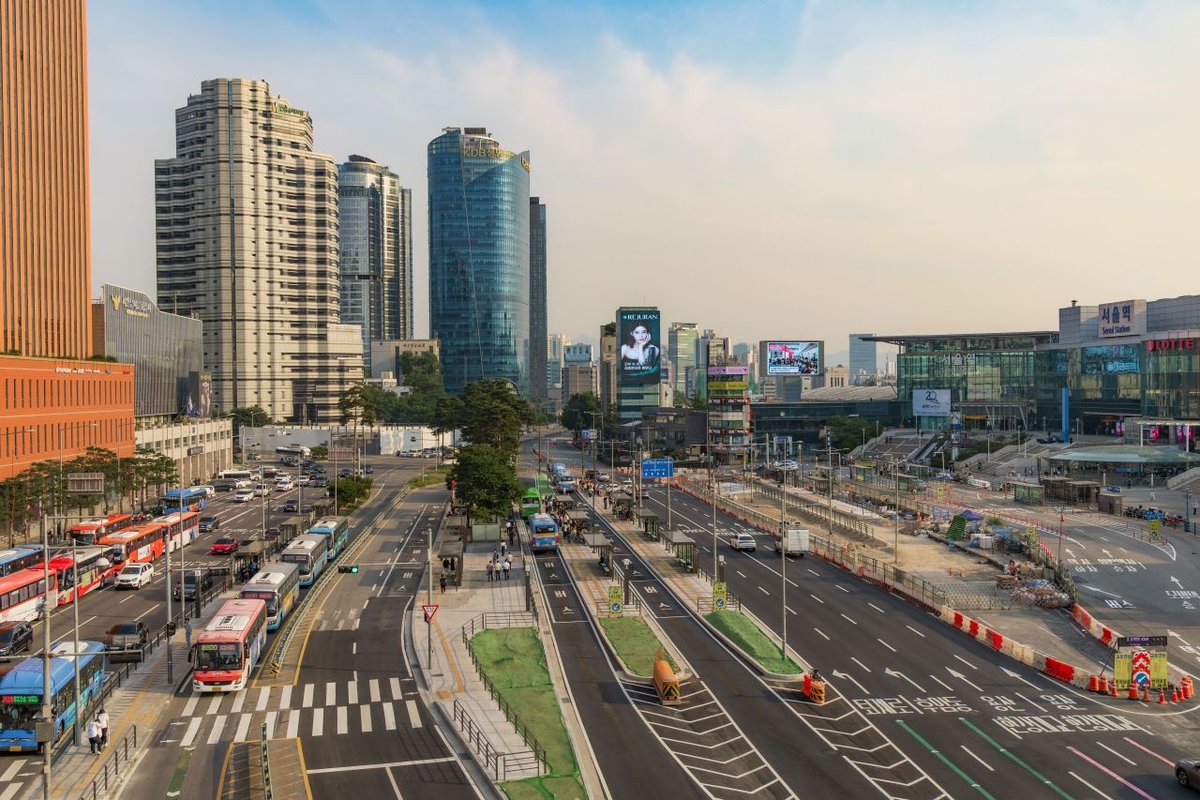
Cashless buses: Seoul city's January 2026 list shows 183 routes that run as cashless buses, including busy downtown routes such as 102, 103, 105, 402, 405, 500, 600 and 704. On these you can't pay with bills or coins. Even where cash is accepted, cash costs the same or more and never gets a transfer discount.
Which card to use:
| Card | Works on Seoul buses? | Best for |
|---|---|---|
| T-money | Yes, all Seoul city and village buses; top up with cash at stations and convenience stores | Most visitors; also works in other Korean cities |
| WOWPASS | Yes, as a T-money card | Visitors who want to load foreign cash at a kiosk |
| Climate Card short-term pass | Yes on Seoul city, village, night and circular buses; not on red wide-area or airport buses | 3+ busy days in Seoul with many rides |
| Foreign Visa/Mastercard tap | We found no official Seoul statement that bus readers accept foreign cards | Don't rely on it |
TOPIS lists T-money, U-Pass, EB Card, Cashbee and Korail membership cards as accepted bus cards. Full details on buying and topping up are in our T-money guide, and the pass is explained in our Climate Card guide.
What a day of bus rides costs
| Plan | Rides | What you pay (adult, card) |
|---|---|---|
| 4 separate blue-bus rides, no transfers | 4 × 1,500 | 6,000 won |
| 2 trips, each bus + subway transfer under 10 km | 2 × about 1,550 | about 3,100 won |
| 6 rides in Seoul with a 1-day Climate Card | Unlimited | 5,000 won (Climate Card post) |
| One late-night N bus home | 1 × 2,500 | 2,500 won |
If you take more than three separate rides a day, compare with the Climate Card. If you mostly walk and ride twice, T-money is cheaper.
Common mistakes
- Not tapping off. You lose the transfer discount and may pay a full new fare on the next ride.
- Trying to pay cash on a cashless route. Carry a transport card.
- Taking a red bus by mistake. Red buses cost 3,000 won and may head straight out of Seoul.
- Using one card for two people on a bus-to-subway trip. The transfer discount only works for one card per person.
- Waiting at the wrong side of a center-lane stop. Check the direction (the next stop name) on the sign or in your map app.
- Expecting the airport bus to take the Climate Card. Airport limousine buses aren't covered; see our Incheon Airport to Seoul guide.
FAQ
How much is a bus in Seoul?
An adult pays 1,500 won by card on a blue or green city bus, 1,200 won on a village bus, 3,000 won on a red wide-area bus and 2,500 won on a night bus (Seoul city, as of November 2026).
Can I pay cash on Seoul buses?
On many routes, yes, at the same adult price, but 183 routes are cashless (Seoul city, January 2026) and cash gets no transfer discount. Use a transport card.
Do I need to tap my card when I get off the bus?
Yes. Seoul city says to tap on and tap off every time. Without the tap-off, your next ride is charged as a new trip.
Are bus transfers free in Seoul?
With a card, a bus or subway ride within 30 minutes of getting off (60 minutes from 21:00 to 07:00) is a transfer: you pay one base fare for the first 10 km plus 100 won per extra 5 km.
Do Seoul buses run all night?
Regular buses stop late at night, but 14 N bus routes run from about 23:00 to 06:00 for 2,500 won (Seoul city).
Final word
Get a T-money card or WOWPASS (or a Climate Card for busy days), find your bus in Naver Map, tap on at the front, tap off at the back, and transfer within 30 minutes to pay one fare for the whole trip. Blue and green buses cost 1,500 won; avoid red buses unless you're leaving Seoul. For your first trip into the city, start with our Incheon Airport to Seoul guide. For short hops in good weather, a Ttareungyi public bike costs 1,000 won for a day of 1-hour rides.